Research tooling · public
Dixon Glacier Model Workbench
A glacier runoff model with its data and assumptions on show
- Year
- 2026
- Role
- Researcher and sole developer
Published 2026-07-23 · Updated 2026-11-09 · By Kai Myers, K.AI Consulting
The problem
The Alaska Energy Authority is actively pursuing the Dixon Diversion: a dam near the glacier's toe and a tunnel of roughly 4.9 miles carrying meltwater to Bradley Lake, the state's largest hydro plant. It would lift Bradley's annual output by about 50 percent (roughly 60 MW, power for up to 30,000 more homes) at a cost of hundreds of millions of dollars.
The case for it rests on how much water Dixon will produce and for how long. A glacier's runoff rises as it melts faster, then falls permanently once there is not enough ice left to sustain the increase. That turning point is peak water, and whether it is decades away or already behind us is central to whether the diversion pencils out.
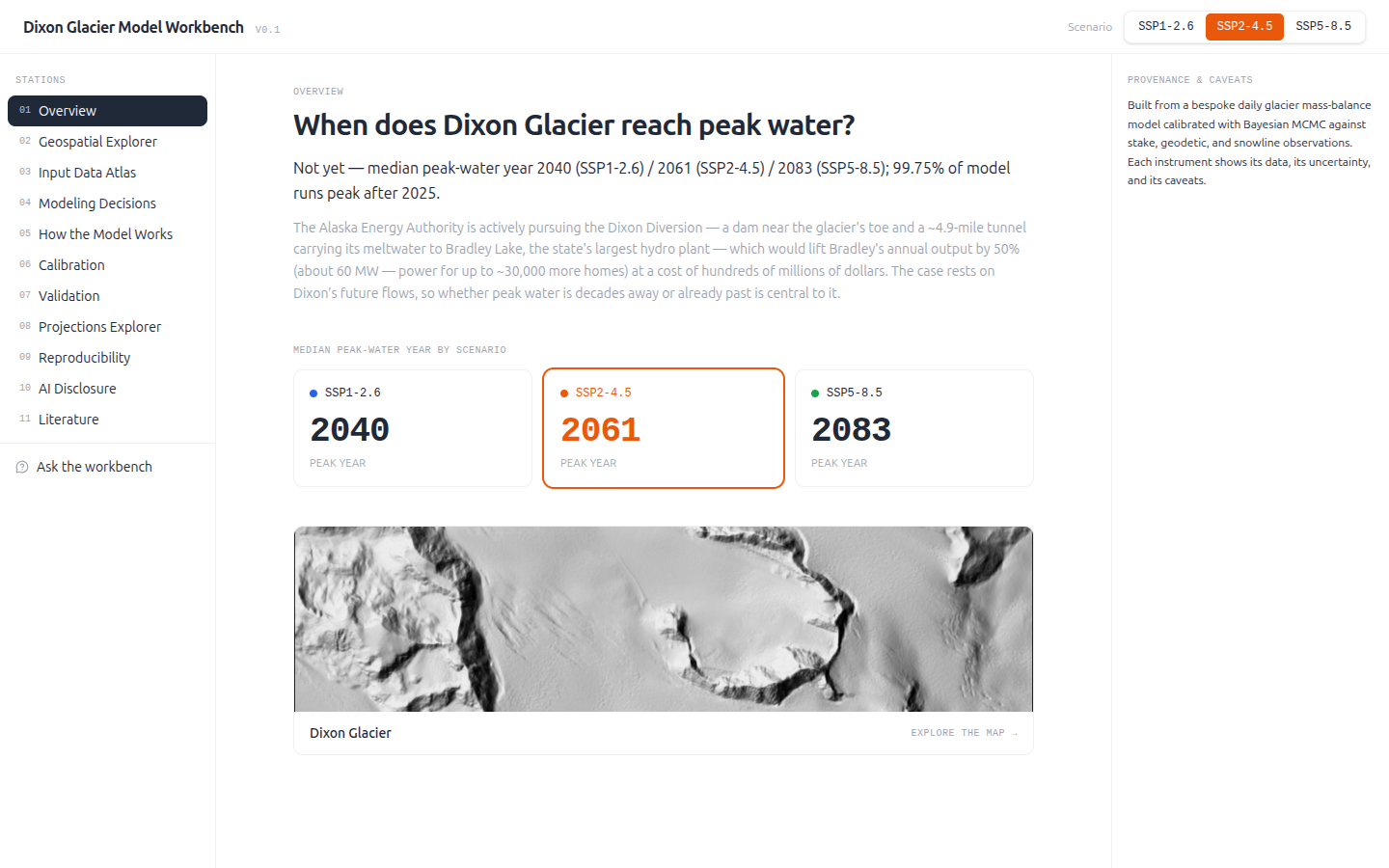
What I built
A daily glacier mass-balance model specific to Dixon, built with AI coding agents and calibrated with Bayesian MCMC against stake measurements, geodetic mass change, and observed snowlines.
A public workbench of thirteen stations, including a geospatial explorer, an atlas of every input dataset with its provenance, the modeling decisions and why each was made, how the model works, calibration, validation, a projections explorer, and reproducibility.
An AI disclosure station documenting how the model was built with LLM assistance and where that assistance was and was not trusted.
A retrieval-backed assistant that answers questions against the model's own corpus, so a reader can ask it questions directly.
Where it landed
- Projects the peak-water year under three emissions scenarios, with the uncertainty shown
- Every input dataset published with source, units, CRS, coverage, and known caveats
- Live at dixonglacier.com
Built with
Got a problem shaped like one of these?